French Last Names in the 1800s
French last names in the 1800s reflected the country’s regional history, occupations, places, family relationships, and older medieval naming traditions. Many surnames found in 19th-century France are still recognizable today, while others have a distinctly old-fashioned or historical feel.
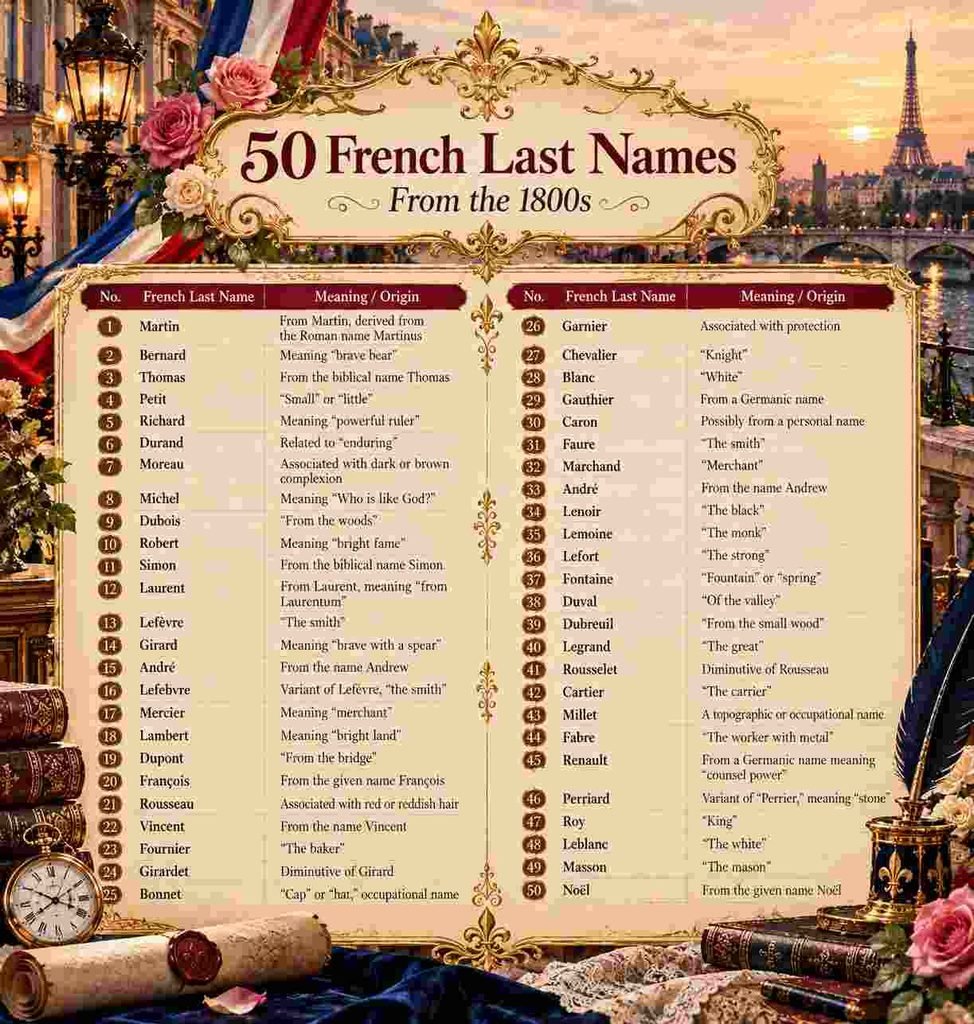
50 French Last Names From the 1800s
| French Last Name | Meaning / Origin |
| Martin | From Martin, derived from the Roman name Martinus |
| Bernard | From Bernard, meaning “brave bear” |
| Thomas | From the biblical given name Thomas |
| Petit | “Small” or “little,” originally a descriptive nickname |
| Richard | From a Germanic name meaning “powerful ruler” |
| Durand | From a personal name related to “enduring” |
| Moreau | A surname associated with a dark or brown complexion |
| Michel | From Michael, meaning “Who is like God?” |
| Dubois | “From the woods” or “of the forest” |
| Robert | From a Germanic personal name meaning “bright fame” |
| Simon | From the biblical name Simon |
| Laurent | From Laurentius, associated with Laurentum |
| Lefebvre | Occupational name for a smith or metalworker |
| Leroy | “The king,” originally a nickname or title-based surname |
| Girard | From a Germanic personal name meaning “brave spear” |
| Rousseau | Related to “red” or reddish coloring |
| David | From the biblical name David |
| Fournier | Occupational surname connected with a baker or oven |
| Lambert | From a Germanic personal name meaning “bright land” |
| Mercier | Occupational name associated with a merchant |
| Blanc | “White,” originally a descriptive nickname |
| Dupont | “From the bridge” |
| Morel | Related to Moreau and sometimes associated with dark coloring |
| Roux | “Red-haired” or reddish |
| Garnier | From a Germanic personal name |
| Faure | Regional form related to the occupational name for a smith |
| André | From Andrew, meaning “manly” or “brave” |
| Fontaine | “Fountain” or “spring” |
| Dufour | “From the oven” |
| Dumont | “From the mountain” |
| Gauthier | From a Germanic personal name meaning “ruler of the army” |
| Perrin | Diminutive form of Pierre |
| Masson | Occupational name related to a mason |
| Henry | From the Germanic personal name Henry |
| Joly | “Cheerful” or “pleasant” |
| Roussel | Diminutive form related to Roux |
| Dupuis | “From the well” |
| Caron | An old surname with several regional origins |
| Leclerc | “The clerk” or educated/clerical person |
| Marchand | “Merchant” or trader |
| Barbier | “Barber” |
| Boucher | “Butcher” |
| Charpentier | “Carpenter” |
| Colin | Diminutive form of Nicolas |
| Meunier | “Miller” |
| Lemoine | “The monk” |
| Mathieu | From Matthew, meaning “gift of God” |
| Olivier | From the personal name Olivier |
| Chevalier | “Knight,” originally a status or nickname |
| Villeneuve | “New town” or “new settlement” |
| Many of these surnames are documented in sources dealing with French families at the end of the 19th century. Genealogical collections also show names such as Allard, André, Achard, Aubert, Aubry, Barbier, Baillet, Durand, Duval, Dupont, Dumas, Dupuy, and Dupré in historical French family records. |
Old-Fashioned French Last Names From the 1800s
Some surnames have a particularly strong 19th-century French feel because of their traditional occupations, regional forms, or older family name structures.
1. Charpentier
Meaning “carpenter,” Charpentier was an occupational surname connected with woodworking and construction.
2. Meunier
Meunier means “miller” and reflects the importance of milling and agricultural trades in traditional French communities.
3. Barbier
Barbier means “barber” and comes directly from an occupation.
4. Boucher
Boucher means “butcher,” another occupational surname that could identify a family’s traditional trade.
5. Leclerc
Leclerc referred historically to a clerk or literate person and has a distinctly traditional French character.
6. Lemoine
Lemoine means “the monk” and developed from a nickname or association with religious life.
7. Fournier
Fournier is connected with the French word for an oven and was associated with baking or operating an oven.
8. Masson
Masson is related to the occupation of mason or stoneworker.
French Aristocratic Last Names in the 1800s
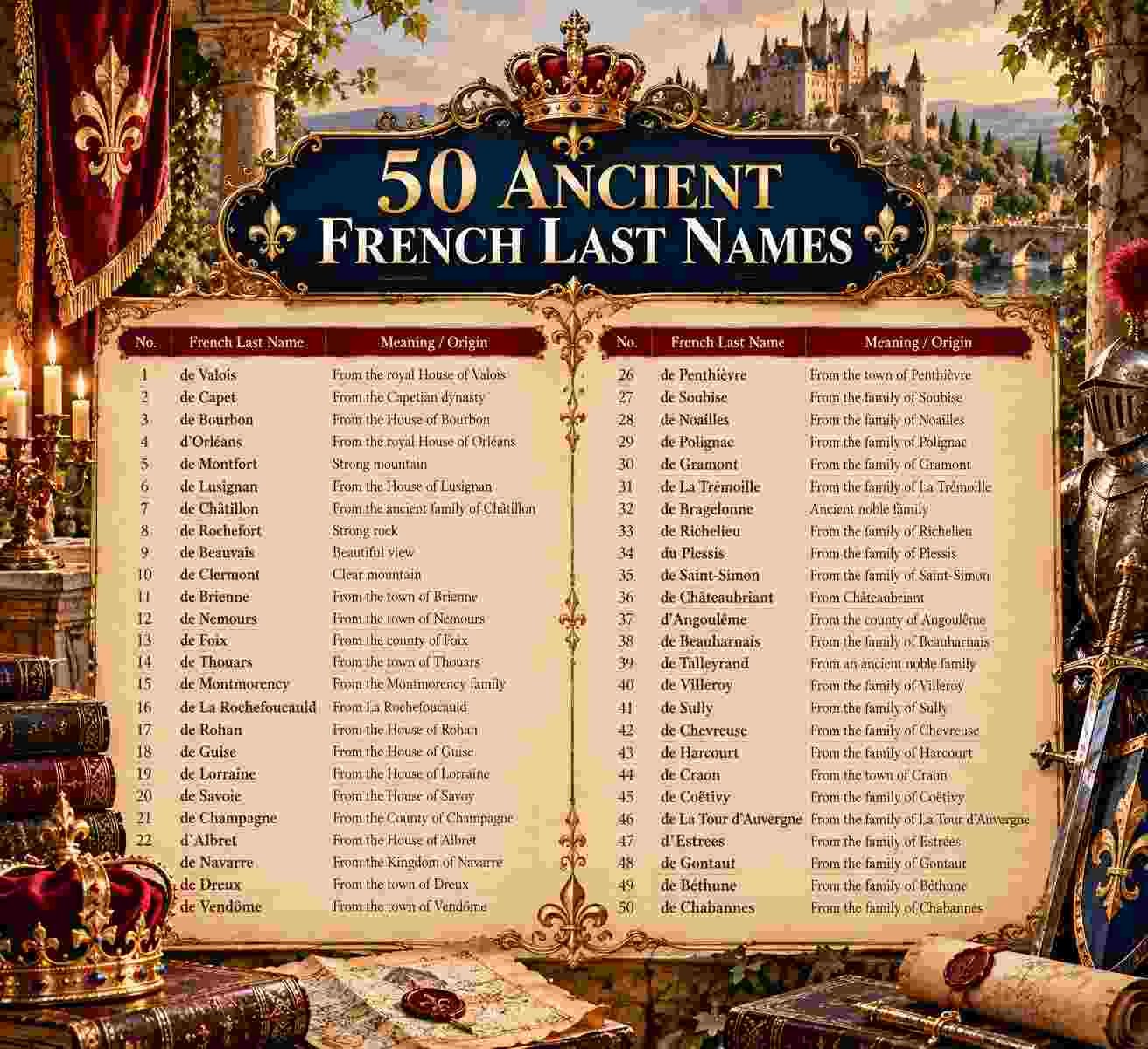
The 19th century also included families with old aristocratic and noble surnames. Historical works covering notable French families at the end of the century contain numerous names using older forms such as “de,” “du,” and “des.”
Examples include:
- de Montmorency
- de La Rochefoucauld
- de Rohan
- de Polignac
- de Noailles
- de Gramont
- de La Tour
- de Bar
- de Bailleul
- de Barrau
- de Beauharnais
These should not all be treated as ordinary surnames of the general population. Some were associated with particular noble or notable families and have specific historical genealogies.
French Occupational Last Names in the 1800s
Occupational surnames were especially recognizable in 19th-century French records.
- Boucher — butcher
- Barbier — barber
- Charpentier — carpenter
- Fournier — baker or oven-related occupation
- Meunier — miller
- Masson — mason
- Marchand — merchant
- Mercier — merchant or textile-goods dealer
- Forgeron — blacksmith
- Pêcheur — fisherman
These names could preserve clues about an ancestor’s earlier occupation even after the family moved into another profession.
French Place-Based Last Names From the 1800s
Many French surnames referred to where a family lived or originated.
1. Dubois
Literally connected with woods or forest.
2. Dupont
Refers to a bridge or someone living near one.
3. Dumont
Means “from the mountain” or “of the mountain.”
4. Fontaine
Refers to a fountain or natural spring.
5. Dupuis
Refers to a well.
6. Villeneuve
Means “new town” or “new settlement.”
7. Deschamps
Means “from the fields.”
8. Delorme
Refers to an elm tree.
9. Dufour
Means “from the oven.”
10. Delacroix
Means “of the cross” or “from the cross.”
French Last Names With a 19th-Century Feel
If you are looking for surnames that sound particularly appropriate for a historical French character, these work well:
- Beaumont
- Bellamy
- Charpentier
- Chevalier
- Delaunay
- Delorme
- Deschamps
- Dupont
- Durand
- Fontaine
- Fournier
- Garnier
- Gauthier
- Lefebvre
- Lemoine
- Mercier
- Moreau
- Rousseau
- Villeneuve
- Vautrin
French Last Names Used in Historical Research
For genealogy, the most useful sources are 19th-century civil registers, census records, and decennial tables. France’s civil registration system recorded births, marriages, and deaths, while decennial tables provided alphabetical indexes to these records.
French censuses also become especially useful during the 19th century. After 1836, censuses were generally conducted every five years, with information such as names, ages, occupations, relationships, and marital status.
Why 1800s French Last Names Are Useful for Characters
A 19th-century French surname can immediately establish a historical setting without sounding artificially medieval. Names such as Durand, Moreau, Fournier, Lefebvre, Charpentier, Rousseau, and Villeneuve can work naturally for characters from different social and regional backgrounds.
For aristocratic characters, historical surnames with de, du, or des can create a different impression, but they should be used carefully because these constructions do not automatically indicate nobility.
FAQs
What were common French last names in the 1800s?
Names such as Martin, Bernard, Thomas, Petit, Richard, Durand, Moreau, Michel, Dubois, Robert, and Simon are among the well-established French surnames found in historical records and surname databases.
Did French people have surnames in the 1800s?
Yes. Hereditary family names were already well established, and French civil registration provided systematic records of surnames in births, marriages, and deaths from the late 18th century onward.
What French surnames sound old-fashioned?
Charpentier, Meunier, Barbier, Boucher, Lemoine, Fournier, Masson, Chevalier, and Leclerc can give a distinctly traditional or historical French impression.
What French surnames were used by nobles?
Historical noble and notable families included surnames such as de Montmorency, de Rohan, de La Rochefoucauld, de Polignac, and de Noailles. These represent particular historical families rather than a general category of French surnames.
Where can I find actual French surnames from the 1800s?
French civil registers, decennial tables, censuses, and genealogical databases are useful sources. FamilySearch, for example, provides a collection of French civil records covering numerous communes and dates extending through 1900.
Final Thoughts
French last names in the 1800s included familiar surnames such as Martin, Bernard, Durand, Moreau, Dubois, Rousseau, and Lefebvre, alongside occupational names such as Boucher, Barbier, Meunier, and Charpentier. Place-based names such as Dupont, Dumont, Fontaine, and Villeneuve also fit naturally into a 19th-century French setting.
For more historical naming inspiration, explore old French surname options with traditional and distinctive characteristics.