French Last Names: 500 Popular Surnames & Meanings & List
French last names reflect family history, occupations, places, nicknames, and older personal names. From familiar surnames like Martin and Bernard to distinctive names like Delorme and Villeneuve, French surnames offer a wide range of styles and origins.
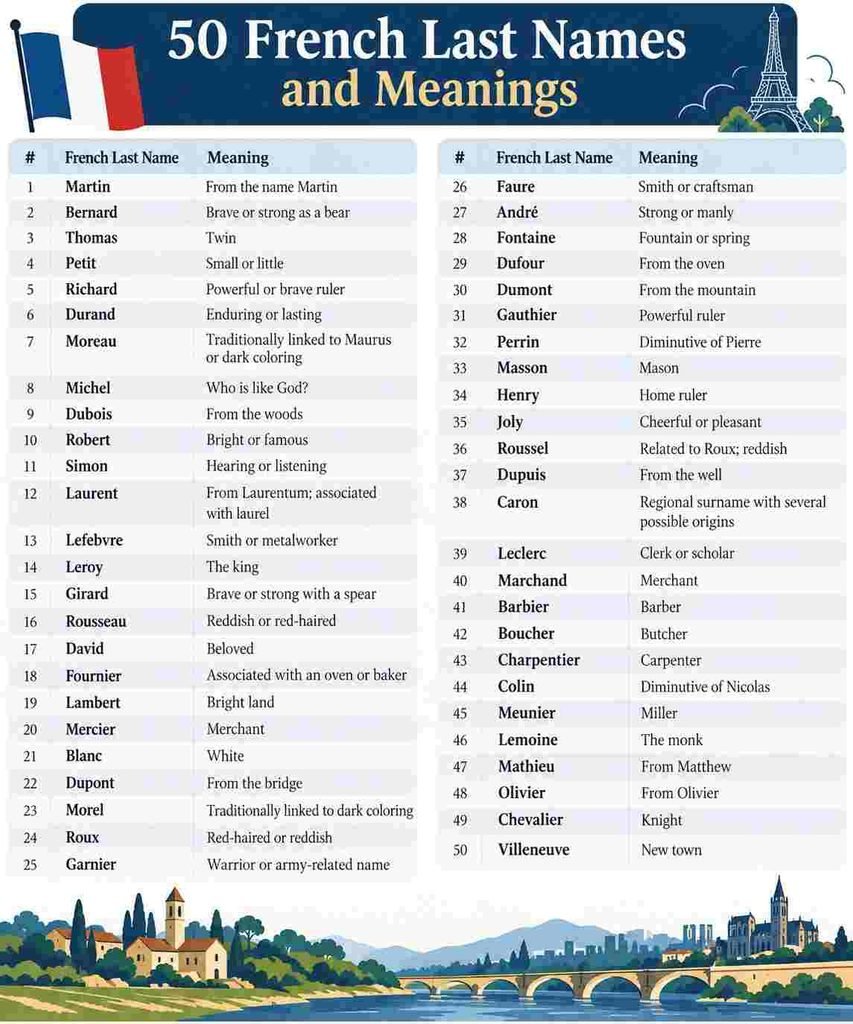
50 French Last Names and Meanings
| French Last Name | Meaning |
| Martin | From the name Martin |
| Bernard | Brave or strong as a bear |
| Thomas | Twin |
| Petit | Small or little |
| Richard | Powerful or brave ruler |
| Durand | Enduring or lasting |
| Moreau | Traditionally linked to Maurus or dark coloring |
| Michel | Who is like God? |
| Dubois | From the woods |
| Robert | Bright or famous |
| Simon | Hearing or listening |
| Laurent | From Laurentum; associated with laurel |
| Lefebvre | Smith or metalworker |
| Leroy | The king |
| Girard | Brave or strong with a spear |
| Rousseau | Reddish or red-haired |
| David | Beloved |
| Fournier | Associated with an oven or baker |
| Lambert | Bright land |
| Mercier | Merchant |
| Blanc | White |
| Dupont | From the bridge |
| Morel | Traditionally linked to dark coloring |
| Roux | Red-haired or reddish |
| Garnier | Warrior or army-related name |
| Faure | Smith or craftsman |
| André | Strong or manly |
| Fontaine | Fountain or spring |
| Dufour | From the oven |
| Dumont | From the mountain |
| Gauthier | Powerful ruler |
| Perrin | Diminutive of Pierre |
| Masson | Mason |
| Henry | Home ruler |
| Joly | Cheerful or pleasant |
| Roussel | Related to Roux; reddish |
| Dupuis | From the well |
| Caron | Regional surname with several possible origins |
| Leclerc | Clerk or scholar |
| Marchand | Merchant |
| Barbier | Barber |
| Boucher | Butcher |
| Charpentier | Carpenter |
| Colin | Diminutive of Nicolas |
| Meunier | Miller |
| Lemoine | The monk |
| Mathieu | From Matthew |
| Olivier | From Olivier |
| Chevalier | Knight |
| Villeneuve | New town |
What Are French Last Names?
French last names, also called French surnames or family names, are hereditary names used to identify families. Many developed from occupations, geographical locations, nicknames, or personal names.
Some surnames are widespread throughout France, while others are strongly associated with particular regions. This means a surname can sometimes provide clues about a family’s historical location or background.
Popular French Last Names
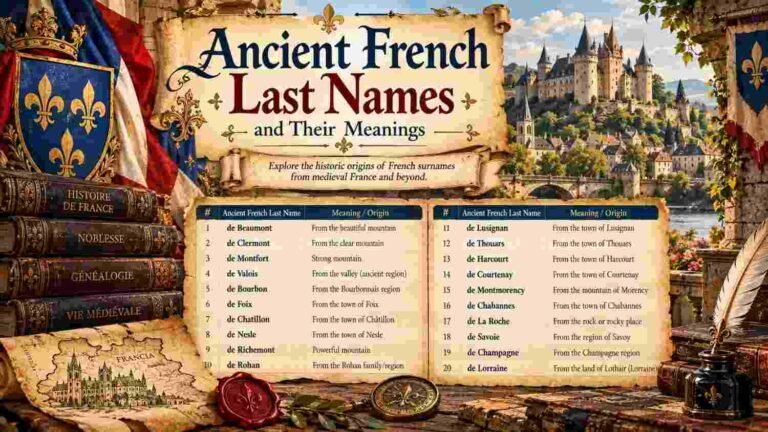
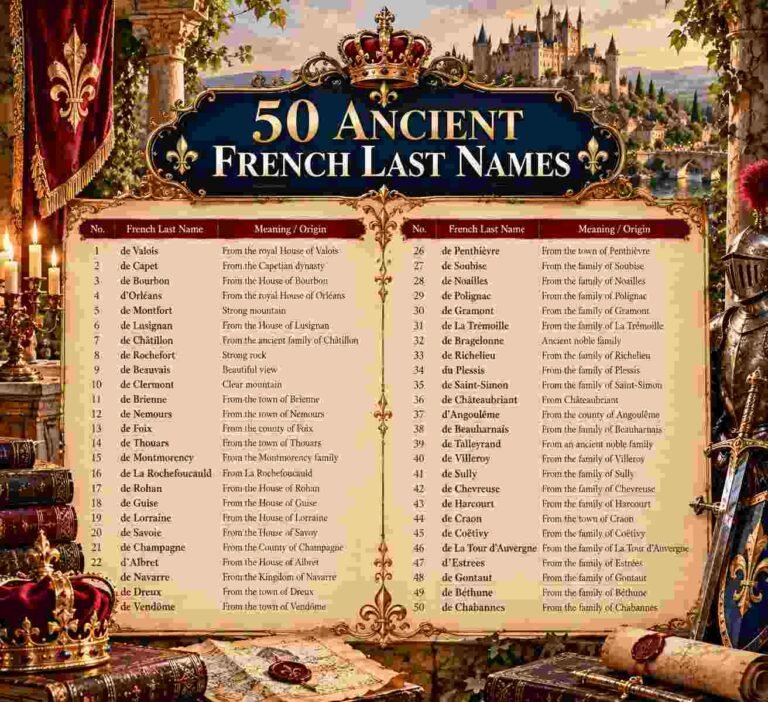
If you are looking for popular French last names, several names appear frequently in French genealogy and surname databases. Martin, Bernard, Thomas, Petit, Richard, Durand, Moreau, Michel, Dubois, and Robert are among the names frequently found in France. If you are also interested in names with historical associations, explore historic French royal surnames for a different type of French naming inspiration. Exact rankings vary depending on the database and records being measured.
1. Martin
Martin is one of the most recognizable French surnames and developed from the personal name Martin. It has historically been widespread throughout France.
2. Bernard
Bernard comes from a Germanic personal name traditionally associated with strength and a bear. It became both a given name and hereditary surname.
3. Thomas
Thomas comes from the biblical name Thomas, traditionally associated with the meaning “twin.” It became a widespread personal name before developing into a family surname.
4. Petit
Petit literally means “small” or “little.” As a surname, it may have originally described someone’s size, age, or position within a family.
5. Richard
Richard is a Germanic name associated with power, strength, and rule. It became an established medieval personal name and later a common surname.
6. Durand
Durand is traditionally associated with the idea of endurance or lasting. It developed from an older personal name and became an established French family name.
7. Moreau
Moreau has several possible historical explanations and is traditionally connected with forms of Maurus or descriptions of dark coloring. It is now a well-known French surname.
8. Michel
Michel comes from Michael, traditionally interpreted as “Who is like God?” It became both a common French given name and surname.
9. Dubois
Dubois comes from du bois, meaning “of the woods” or “from the wood.” It is an example of a French topographic surname.
10. Robert
Robert comes from a Germanic personal name traditionally associated with fame and brightness. It became common as both a first name and family name.
French Last Names List
A broader French last names list includes surnames based on occupations, landscapes, personal names, physical descriptions, and places. These names can be useful for genealogy, character creation, family-history research, or simply learning about French naming traditions.
French Last Names by Origin
French surnames developed in several major ways. Understanding these categories makes it easier to recognize where a surname may have come from.
Patronymic French Last Names
Patronymic surnames developed from personal names. A family could become identified through the first name of a father, ancestor, or another relative.
Examples include Martin, Bernard, Robert, Richard, Thomas, Michel, Laurent, David, and Mathieu.
Occupational French Last Names
Many French surnames came from the work someone performed. In medieval communities, an occupation could be an easy way to distinguish people who shared the same first name.
Examples include:
- Fournier — associated with an oven or baker
- Lefebvre — smith or metalworker
- Meunier — miller
- Boucher — butcher
- Barbier — barber
- Charpentier — carpenter
- Masson — mason
- Marchand — merchant
- Mercier — merchant
Topographic French Last Names
Topographic surnames describe a geographical feature or location connected to an ancestor.
Dubois relates to woods, Dupont to a bridge, Dumont to a mountain, Dupuis to a well, and Fontaine to a fountain or spring.
These names show how the surrounding landscape could become part of a family’s identity.
Nickname-Based French Last Names
Some surnames developed from descriptions of a person’s appearance, personality, age, or other noticeable characteristic.
Examples include Petit, Blanc, Roux, Rousseau, Joly, and Sauvage.
The original description does not necessarily describe later generations. A surname could remain in a family long after its original meaning was no longer relevant.
Place-Based French Last Names
Some French surnames developed from villages, towns, estates, or other locations. These can be more difficult to interpret because historical place names and spellings have changed over time.
Regional genealogy research can be particularly useful when trying to identify the original location behind a surname.
French Last Names With Le
French surnames beginning with Le are common and often contain a descriptive word after the article le, meaning “the.”
Examples include:
- Leroy — the king
- Leclerc — the clerk
- Lemoine — the monk
- Leblanc — the white
- Legrand — the great or tall
- Lecomte — the count
- Lebrun — the brown or dark-haired
These surnames do not necessarily indicate that an ancestor literally held the title or occupation suggested by the name. Many began as nicknames or descriptions.
French Last Names Beginning With Du
The prefix Du is another recognizable feature of French surnames. It often developed from de + le and can convey an idea such as “of the” or “from the.”
Examples include:
- Dubois — from the woods
- Dupont — from the bridge
- Dufour — from the oven
- Dumont — from the mountain
- Dupuis — from the well
- Dufresne — from the ash tree
These names demonstrate how French articles and prepositions became incorporated into hereditary surnames.
Regional French Last Names
France has significant regional linguistic and cultural diversity, and this is reflected in its surnames. Breton, Basque, Occitan, Norman, Picard, Provençal, Alsatian, and other traditions have contributed to the country’s surname landscape.
A surname that is relatively uncommon across France may be strongly established in one region. This is why regional records can be important when researching a French family name.
Elegant French Last Names
If you are looking for French surnames with a refined or classic sound, consider:
- Beaumont
- Bellamy
- Chevalier
- Delacroix
- Fontaine
- Laurent
- Montfort
- Rousseau
- Villeneuve
- Delaunay
“Elegant” is subjective rather than an official surname category, but these names can work well for fictional characters, pen names, historical writing, or creative projects.
Rare French Last Names
There is no single definitive list of the rarest French surnames because surname frequency changes by region and database. If you want an unusual French surname, consider looking at regional names rather than simply choosing a name that sounds unfamiliar. Names such as Delaunay, Delorme, Deschamps, Dufresne, Montagnier, Pruvost, Vasseur, and Descamps can provide less familiar options.
French Last Names for Characters
French surnames are useful for contemporary, historical, romantic, literary, and fantasy characters. The right choice depends on the character’s period, region, and social background.
For a modern character, common surnames such as Martin, Dubois, Moreau, Laurent, Bernard, or Rousseau can feel natural.
For historical fiction, it is better to research the period and location rather than choosing a surname simply because it sounds French.
French Last Names for Girls and Boys
French surnames generally do not change based on whether the person is male or female. The same family surname can be used by everyone in the family.
For example, Dubois, Martin, Moreau, Dupont, Laurent, and Rousseau can all be surnames for women, men, and children.
This differs from French first names, which generally have masculine and feminine forms.
French Last Names and Family History
If you are researching a French surname, the meaning is only one part of the story. Historical records may reveal different spellings, regional forms, and connections to specific towns or families.
Older records can also contain spelling variations because surnames were not always standardized. A modern surname may therefore appear in several forms in historical documents.
Genealogy databases can help researchers investigate surname distribution, historical records, and possible origins.
How French Last Names Were Formed
Many French surnames developed because communities needed a way to distinguish people with the same first name.Imagine a village with several people named Jean. One might be identified by his occupation, another by where he lived, another by his appearance, and another through a parent’s name.Over generations, these descriptions became hereditary family names. If you’re exploring French naming traditions, a French name generator can also provide inspiration for combining first names and surnames.
100 French Last Names
If you need a larger French last names list, these 100 names provide a mix of popular, traditional, occupational, descriptive, and regional surnames:
- Martin
- Bernard
- Thomas
- Petit
- Richard
- Durand
- Moreau
- Michel
- Dubois
- Robert
- Simon
- Laurent
- Lefebvre
- Leroy
- Girard
- Rousseau
- David
- Fournier
- Lambert
- Mercier
- Blanc
- Dupont
- Morel
- Roux
- Garnier
- Faure
- André
- Fontaine
- Dufour
- Dumont
- Gauthier
- Perrin
- Masson
- Henry
- Joly
- Roussel
- Dupuis
- Caron
- Leclerc
- Marchand
- Barbier
- Boucher
- Charpentier
- Colin
- Cousin
- Denis
- Gérard
- Granger
- Lemoine
- Mathieu
- Meunier
- Olivier
- Pascal
- Rey
- Robin
- Roger
- Roy
- Sauvage
- Vidal
- Vincent
- Alexandre
- Allard
- Aubert
- Benoît
- Bertrand
- Clément
- Fleury
- François
- Gautier
- Gilbert
- Guillaume
- Jacques
- Julien
- Léger
- Léonard
- Marcel
- Nicolas
- Philippe
- Pierre
- René
- Sébastien
- Théodore
- Victor
- Beaumont
- Delorme
- Deschamps
- Delaunay
- Dufresne
- Legrand
- Lecomte
- Lebrun
- Villeneuve
- Montfort
- Aubry
- Vasseur
- Descamps
- Carpentier
- Pruvost
- Chevalier
- Bellamy
Tips for Choosing a French Last Name
1. Decide whether you want common or unusual: Martin and Bernard feel familiar, while a regional surname can create a more distinctive identity.
2. Consider the meaning: Occupational, place-based, and descriptive surnames can add another layer to a character or family name.
3. Think about pronunciation: Names such as Dubois, Rousseau, Lefebvre, and Dufour may need pronunciation guidance for English-speaking readers.
4. Match the historical period: If authenticity matters, make sure the surname fits the character’s time and location.
5. Consider the first name: Think about how the rhythm of the first and last names works together.
6. Check regional associations: A surname may have a stronger connection to Brittany, Normandy, Provence, the north of France, or another area.
7. Look beyond the literal translation: A surname’s modern meaning does not always explain its original historical development.
If you’re also looking for first-name inspiration, explore french girl names for feminine options with a distinctly French feel.
FAQs
What Is the Most Common French Last Name?
Martin is among the most frequently recorded French surnames, although rankings can vary depending on the database and population being measured.
What Are Some Popular French Last Names?
Popular French surnames include Martin, Bernard, Thomas, Petit, Richard, Durand, Moreau, Michel, Dubois, Robert, Simon, Laurent, Lefebvre, and Leroy.
What Does Dubois Mean?
Dubois comes from du bois, meaning “of the woods” or “from the wood.” It is generally understood as a topographic surname.
What Does Dupont Mean?
Dupont comes from du pont, meaning “of the bridge” or “from the bridge.”
What Does Lefebvre Mean?
Lefebvre is an occupational surname historically associated with a smith or metalworker.
What Does Petit Mean as a French Last Name?
Petit means “small” or “little.” It may originally have been a nickname describing someone’s size, age, or position.
Are French Last Names Gendered?
Generally, no. French family names do not normally change between male and female family members.
Do All French Surnames Have French Origins?
No. Modern France has a long history of regional diversity, migration, and cultural exchange, so surnames found in France can have many linguistic origins.
What Are Some Elegant French Last Names?
Beaumont, Bellamy, Delacroix, Fontaine, Montfort, Rousseau, Laurent, and Villeneuve can have a refined or elegant sound, although this is subjective.
Are French Last Names Good for Fictional Characters?
Yes. French surnames can work well for modern, historical, romantic, literary, and fantasy characters. For historical characters, match the surname to the appropriate period and region.
Final Thoughts
French last names can reveal traces of family history, geography, occupations, personal names, and old nicknames. Popular names such as Martin, Bernard, Dubois, Moreau, Durand, and Rousseau provide familiar choices, while regional and occupational surnames offer more distinctive options. Whether you need a French last names list for research, genealogy, or character creation, understanding the surname’s origin can make your choice more meaningful.