Old French Last Names: Ancient Surnames & Meanings
Old french last names preserve clues about medieval families, feudal territories, occupations, places, and personal names.This ancient french last names list includes historical surnames and family names documented in medieval or early-modern French sources, with notes on their origins and associations.
50 Old French Last Names and Meanings
| Old French Last Name | Meaning / Historical Association |
| Bourbon | From the Bourbon place and family |
| Beaumont | Beautiful mountain or hill |
| Beaujeu | Beautiful place or landscape |
| Chastillon | Associated with a castle or fortified place |
| Laval | From a valley or the place Laval |
| Rochefort | Strong rock or fortified rock |
| Villiers | From a place or estate called Villiers |
| Vaux | From a valley |
| Dreux | Place-based medieval family name |
| Chauvigny | From Chauvigny |
| Chabannes | Medieval family name associated with Chabannes |
| Maillé | From Maillé |
| Beaufort | Beautiful or strong fort |
| Villars | Place-based surname |
| Aubigny | From Aubigny |
| Beaumont | Beautiful mountain |
| Montfort | Strong mountain or fortified hill |
| La Faye | From a beech tree or place called Faye |
| La Garde | Guard or fortified place |
| La Roche | From the rock |
| Du Bois | From the woods |
| Du Plessis | From a fenced enclosure or place |
| Du Bosc | From the woodland |
| Du Vergier | From the orchard |
| De Vaux | From the valley |
| De France | Of France |
| De Mons | From the mountain or hill |
| De Culant | Place-based family name |
| De Broc | Medieval place-based surname |
| De Maille | From Maille |
| De Villiers | From Villiers |
| De Beaujeu | From Beaujeu |
| De Beauvau | From Beauvau |
| De Chauvigny | From Chauvigny |
| De Rochefort | From Rochefort |
| Martel | Hammer; famous medieval family name |
| Renaud | From the medieval personal name Renaud |
| Rigaud | From an old Germanic personal name |
| Seguin | Medieval personal name |
| Ferrand | From a medieval personal name |
| Garnier | From a Germanic personal name |
| Aubert | From a Germanic personal name |
| Bertrand | From a Germanic personal name |
| Girard | From a Germanic personal name |
| Bernard | From a Germanic personal name |
| Fournier | Associated with an oven or baker |
| Chevalier | Knight |
| Le Clerc | Clerk or scholar |
| Perrot | Diminutive of Pierre |
| Roussel | Related to Roux or reddish coloring |
What Are Old French Last Names?
Old French last names are family names with historical use in France, particularly names documented during the medieval and early-modern periods. Some developed from places and feudal territories, while others came from personal names, occupations, nicknames, or physical features.
It is important to distinguish an old surname from an old spelling. A modern surname may have medieval roots even if its present spelling developed much later.
Historical French archives contain family records going back many centuries. For example, FranceArchives catalogs family-title collections in Brittany dating from 1389 onward, while other archival collections contain family documents dating as far back as the eleventh century.
What Are Ancient French Last Names?
The phrase ancient French last names is commonly used for surnames associated with medieval France or earlier historical periods. However, there is no single official category called “ancient French surnames.”
Some names are ancient because they appear in medieval records. Others are modern forms of much older personal names or place names.
For example, historical genealogical works documenting French feudal families from the 12th century through the 18th century include names such as Bourbon, Beaujeu, Dreux, Laval, Châtillon, Rochefort, Villars, Maillé, Martel, Renaud, Rigaud, Seguin, and Roussel.
Old French Noble Last Names
Some of the most recognizable ancient French surnames are connected with medieval noble or feudal families. Historical records should be used carefully here because a surname’s appearance in a noble genealogy does not mean everyone who later carried that surname belonged to the same noble family.
Examples of historically documented family names include:
1. Bourbon
Bourbon is one of the most famous historical French family names. It is associated with the House of Bourbon and also derives from the place name Bourbon. It is also one of most popular french last names.
2. Beaujeu
Beaujeu appears in historical feudal records and is associated with the medieval family of Beaujeu. The name has a distinctly place-based character.
3. Dreux
Dreux is an old French place and family name with medieval associations. The name is particularly connected with the medieval counts of Dreux.
4. Laval
Laval is a place-based surname associated with the town and historic lordship of Laval. It has deep medieval associations in French history.
5. Châtillon
Châtillon is associated with numerous French places called Châtillon and with several medieval noble families. The name relates to a fortified place or castle.
6. Rochefort
Rochefort is a place-based name built from elements associated with a rock and strength or fortification. Historical families bearing the name appear in French feudal sources.
7. Montfort
Montfort combines the ideas of a mountain or hill and strength or fortification. It appears in medieval French place and family names.
8. Villiers
Villiers is a historical place-based surname found in French records and associated with various locations and families.
9. Beaufort
Beaufort combines beau, meaning beautiful, with fort, meaning strong or fortified. It became a place and family name in medieval France.
10. La Roche
La Roche is associated with a rock or rocky place and appears in numerous French place names and historical family names.
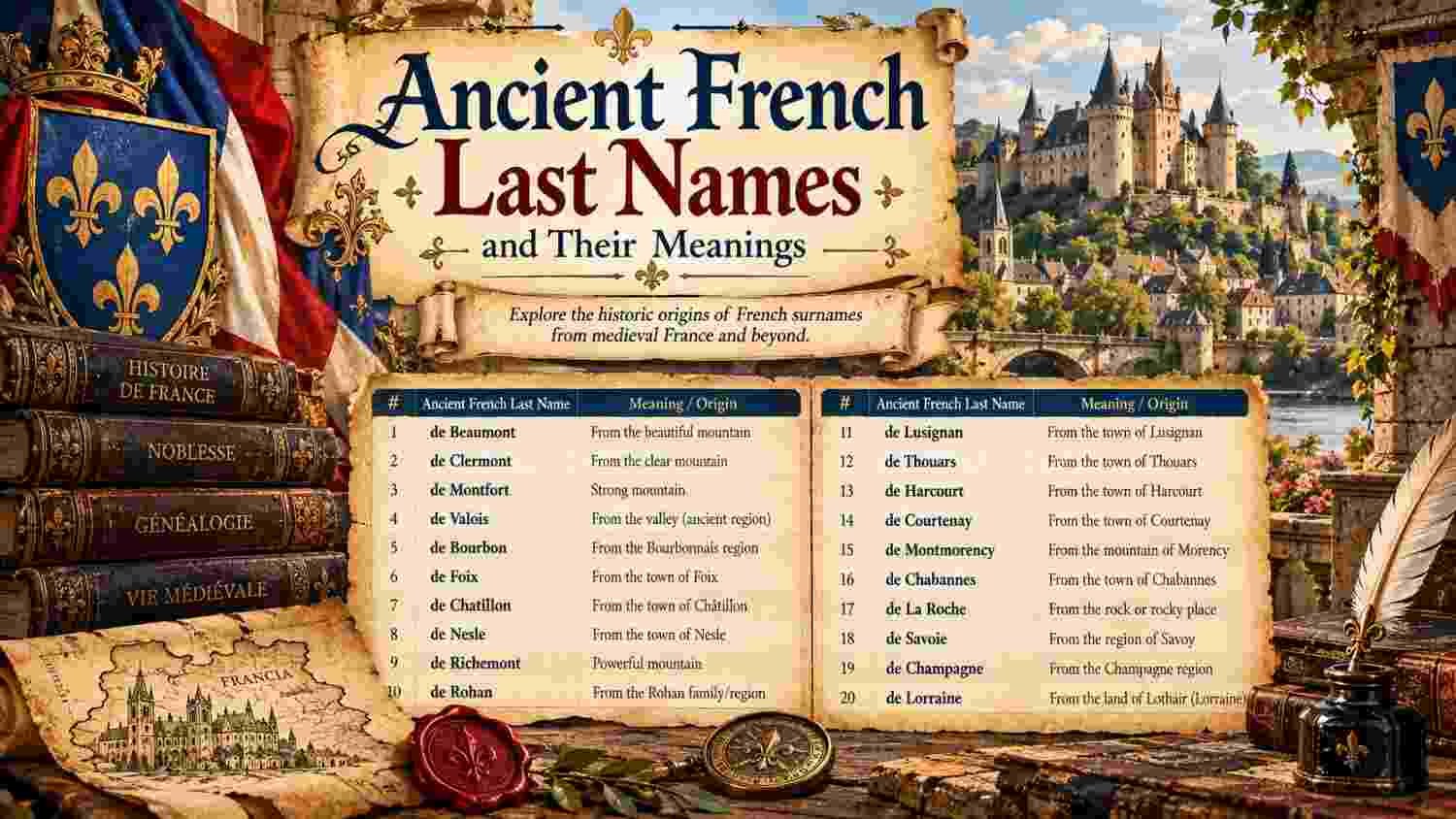
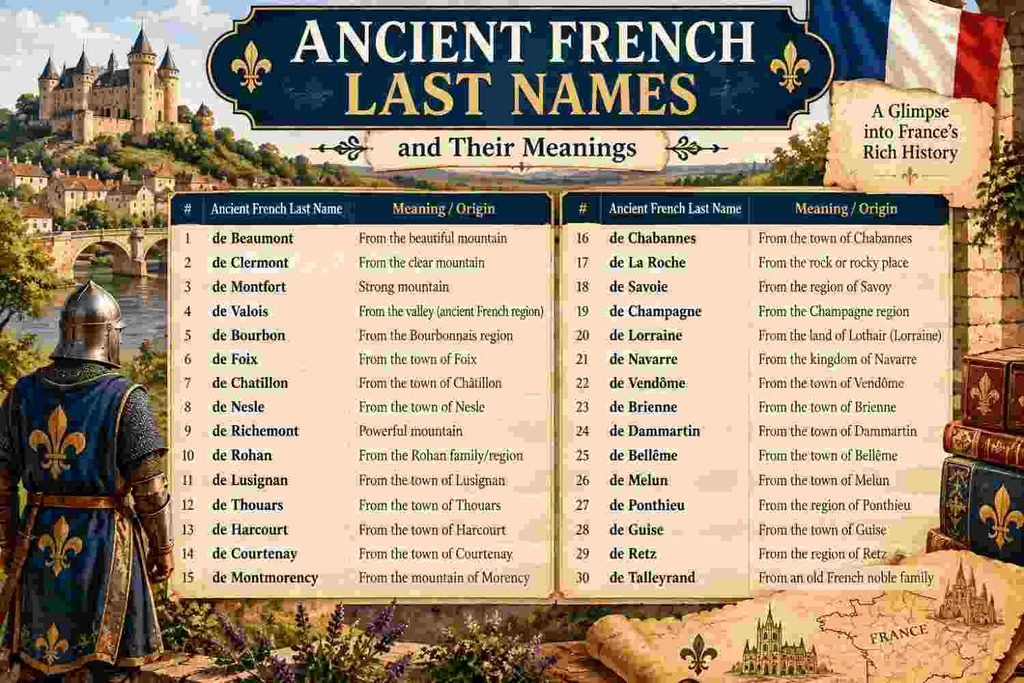
Old French Surnames Beginning With “De”
The prefix de is strongly associated with historical French surnames, particularly place-based and aristocratic names. It generally conveys an association with a place rather than automatically proving noble status.
Examples include:
- de Bourbon
- de Beaujeu
- de Laval
- de Châtillon
- de Rochefort
- de Villiers
- de Vaux
- de Beauvau
- de Maillé
- de Chauvigny
Historical French sources contain many such constructions. A Geneanet catalog of feudal names, for example, includes de Bourbon, de la Roche, de Beaujeu, de Laval, de Beauvau, de Châtillon, de Rochefort, de Villars, de Maillé, and numerous others.
Old French Surnames Beginning With “Du”
The construction du can reflect de + le and often connects a family name with a place, landscape, or object.
Examples include:
- Du Bois — from the woods
- Du Plessis — associated with a fenced enclosure or place
- Du Bosc — from the woodland
- Du Vergier — from the orchard
- Du Lac — from the lake
- Du Pré — from the meadow
Historical feudal-name collections contain examples such as du Bois, du Plessis, du Bosc, du Vergier, and du Lac.
Medieval French Last Names From Personal Names
Not every ancient French surname came from a castle or noble estate. Many developed from medieval personal names.
Examples include:
- Renaud
- Rigaud
- Seguin
- Ferrand
- Garnier
- Aubert
- Bertrand
- Girard
- Bernard
- Perrot
These names reflect the importance of personal names in medieval surname formation. Some ultimately derive from older Germanic names that became established in medieval France.
The historical feudal surname sources contain numerous examples, including Renaud, Rigaud, Seguin, Ferrand, Garnier, Aubert, and Bertrand.
Ancient French Occupational Last Names
Occupations also produced French surnames that have survived from earlier periods.
Fournier is associated with an oven or baker, Chevalier means knight, and Le Clerc refers to a clerk or scholar. Historical records show these names among families documented in France over several centuries.
These surnames are especially useful if you want an old French name that does not necessarily imply aristocratic ancestry.
Old French Place-Based Last Names
Place-based surnames are particularly important in historical French naming. A family might be identified by the village, estate, valley, woodland, mountain, or fortified location associated with it.
Examples include:
Beaumont, Beaujeu, Chauvigny, Laval, Rochefort, Montfort, Villiers, Vaux, La Roche, La Faye, and La Garde.
The same place-based surname can also have developed independently in different parts of France. Therefore, sharing a surname does not automatically mean two families descend from the same medieval line.
Old French Last Names From Medieval Records
Historical records provide useful evidence for identifying genuinely old French family names. A Geneanet publication on feudal names lists hundreds of family names connected with French fiefs from the 12th century through approximately the middle of the 18th century.
The names include Bourbon, Beaujeu, Dreux, Laval, Châtillon, Rochefort, Villars, Maillé, Martel, Renaud, Rigaud, Seguin, Roussel, Fournier, Garnier, Aubert, and many others.
French departmental archives also preserve medieval and early-modern family records. For example, FranceArchives lists family-title collections in Côtes-d’Armor covering 1389–1900 and an Isère collection containing family titles dating as far back as 1085.
Old French Last Names for Characters
If you need an old French last name for a character, choose according to the character’s period and background.
For a medieval noble character, names such as de Bourbon, de Laval, de Châtillon, de Beaujeu, de Rochefort, or de Villiers can provide a historically inspired setting.
For a medieval merchant, craftsman, or ordinary villager, names such as Fournier, Le Clerc, Chevalier, Roussel, Perrot, or Garnier may create a different impression.
For historical fiction, avoid assuming that every surname beginning with de indicates nobility. The prefix often indicates a geographical association, and historical social status must be established from records.
Rare Ancient French Last Names
Some old French surnames are uncommon today but appear in historical sources. Examples include Celerier, Beraud, Baraton, Heurtault, Bourdaloüe, Espinace, Gassot, Douhet, Coiffier, and Chol.
These names appear in the historical feudal-name material cataloged by Geneanet, although historical occurrence does not necessarily mean that a surname is extinct or rare in modern France.
Ancient French Last Names With Strong Historical Associations
If you want names that immediately suggest medieval or early-modern French history, consider:
Bourbon, Beaujeu, Dreux, Laval, Châtillon, Rochefort, Montfort, Beaufort, Villiers, Chauvigny, Maillé, Martel, La Roche, La Garde, and de Vaux.
These names are particularly useful for historical fiction because many have documented connections to places, families, or feudal structures.
How to Choose an Old French Last Name
1. Choose the historical period: Medieval France, the Renaissance, and the Ancien Régime had different naming contexts.
2. Consider social background: A noble family name and an occupational surname can create very different historical impressions.
3. Check the region: Brittany, Normandy, Burgundy, Provence, and other regions had their own naming traditions.
4. Look at the original spelling: Historical documents may use spellings that differ from the modern form.
5. Do not assume “de” means noble: A geographical surname can use de without proving aristocratic status.
6. Check historical records: If accuracy matters, use archives or genealogy sources rather than relying only on a modern surname list.
FAQs
What Is the Oldest French Last Name?
There is no single universally accepted “oldest French last name.” Surnames developed gradually, and different families began using hereditary names at different times.
What Are Some Ancient French Last Names?
Examples include Bourbon, Beaujeu, Dreux, Laval, Châtillon, Rochefort, Montfort, Villiers, Beaufort, Maillé, Martel, and Roussel, all of which have historical documentation or medieval associations.
Are French Last Names With “De” Noble?
Not necessarily. De often indicates a geographical association. Some families using de were noble, but the prefix by itself does not establish noble status.
What Are Some Medieval French Surnames?
Medieval or historically documented examples include Renaud, Rigaud, Seguin, Martel, Ferrand, Garnier, Aubert, Bertrand, Roussel, and Chevalier.
What Are Some Old French Noble Family Names?
Historically prominent examples include Bourbon, Beaujeu, Laval, Châtillon, Dreux, Rochefort, Beaufort, and Villiers. Their historical status belongs to particular families and should not automatically be attributed to everyone who later carried the same surname.
Can I Use an Old French Last Name for a Modern Character?
Yes. Many historical French surnames remain recognizable today. However, if you want the character to feel historically authentic, choose a surname appropriate to the character’s region and period.
Are Ancient French Last Names Still Used?
Some are still used in modern France, while others are rare or primarily encountered in historical and genealogical records. A historical surname can survive even when its original medieval context has disappeared.
Final Thoughts
Old French last names reveal the influence of medieval places, personal names, occupations, landscapes, and feudal families on French naming traditions. Names such as Bourbon, Beaujeu, Laval, Châtillon, Rochefort, Montfort, Renaud, Seguin, Fournier, and Roussel provide different examples of how French surnames developed.
If you are looking for ancient French last names for genealogy or historical fiction, focus on the period, region, and family context rather than choosing a surname simply because it sounds old. Historical archives and genealogy sources can help establish whether a name was actually documented in the period you are researching.