French Last Names 1700s
French last names 1700s offer a glimpse into family history, regional traditions, occupations, and the social world of 18th-century France. For more historical surname inspiration, explore old-fashioned French surnames for traditional names with a distinctive historical character. Check the list below.
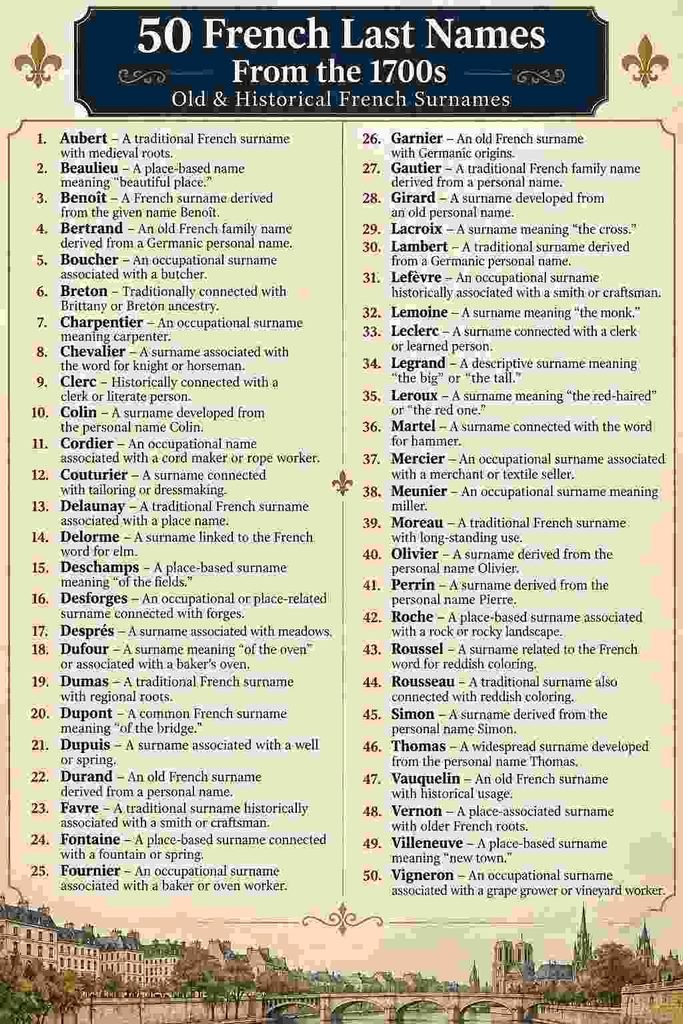
50 French Last Names From the 1700s
- Aubert – A traditional French surname with medieval roots.
- Beaulieu – A place-based name meaning “beautiful place.”
- Benoît – A French surname derived from the given name Benoît.
- Bertrand – An old French family name derived from a Germanic personal name.
- Boucher – An occupational surname associated with a butcher.
- Breton – Traditionally connected with Brittany or Breton ancestry.
- Charpentier – An occupational surname meaning carpenter.
- Chevalier – A surname associated with the word for knight or horseman.
- Clerc – Historically connected with a clerk or literate person.
- Colin – A surname developed from the personal name Colin.
- Cordier – An occupational name associated with a cord maker or rope worker.
- Couturier – A surname connected with tailoring or dressmaking.
- Delaunay – A traditional French surname associated with a place name.
- Delorme – A surname linked to the French word for elm.
- Deschamps – A place-based surname meaning “of the fields.”
- Desforges – An occupational or place-related surname connected with forges.
- Després – A surname associated with meadows.
- Dufour – A surname meaning “of the oven” or associated with a baker’s oven.
- Dumas – A traditional French surname with regional roots.
- Dupont – A common French surname meaning “of the bridge.”
- Dupuis – A surname associated with a well or spring.
- Durand – An old French surname derived from a personal name.
- Favre – A traditional surname historically associated with a smith or craftsman.
- Fontaine – A place-based surname connected with a fountain or spring.
- Fournier – An occupational surname associated with a baker or oven worker.
- Garnier – An old French surname with Germanic origins.
- Gautier – A traditional French family name derived from a personal name.
- Girard – A surname developed from an old personal name.
- Lacroix – A surname meaning “the cross.”
- Lambert – A traditional surname derived from a Germanic personal name.
- Lefèvre – An occupational surname historically associated with a smith or craftsman.
- Lemoine – A surname meaning “the monk.”
- Leclerc – A surname connected with a clerk or learned person.
- Legrand – A descriptive surname meaning “the big” or “the tall.”
- Leroux – A surname meaning “the red-haired” or “the red one.”
- Martel – A surname connected with the word for hammer.
- Mercier – An occupational surname associated with a merchant or textile seller.
- Meunier – An occupational surname meaning miller.
- Moreau – A traditional French surname with long-standing use.
- Olivier – A surname derived from the personal name Olivier.
- Perrin – A surname derived from the personal name Pierre.
- Roche – A place-based surname associated with a rock or rocky landscape.
- Roussel – A surname related to the French word for reddish coloring.
- Rousseau – A traditional surname also connected with reddish coloring.
- Simon – A surname derived from the personal name Simon.
- Thomas – A widespread surname developed from the personal name Thomas.
- Vauquelin – An old French surname with historical usage.
- Vernon – A place-associated surname with older French roots.
- Villeneuve – A place-based surname meaning “new town.”
- Vigneron – An occupational surname associated with a grape grower or vineyard worker.
Occupational French Surnames From the 1700s
Many French family names reflected the work performed by an ancestor. These surnames can be especially useful when looking for names with a distinctly historical or traditional character. Boucher referred to a butcher, Charpentier to a carpenter, Couturier to a tailor, Fournier was associated with an oven or baker, Lefèvre was connected with a smith or craftsman, Meunier meant miller, Mercier was associated with a merchant, and Vigneron referred to someone who worked with vineyards.
French Place-Based Surnames From the 1700s
Geography also played an important role in French surnames. Names could identify where a family lived or where an ancestor came from. Beaulieu, Fontaine, Dupont, Deschamps, Delorme, Dufour, Roche, and Villeneuve all have connections to places, landscape features, or locations. These names can give a historical French character a strong sense of regional identity.
Old French Surnames With a Noble Feel
Some 18th-century French surnames have an elegant or aristocratic sound, particularly names connected with estates, places, or established families. Examples include Beaulieu, Villeneuve, Roche, Vauquelin, Lafayette, Montfort, and Rochefort. However, a surname sounding aristocratic does not automatically mean that every family carrying it belonged to the nobility. Historical status depended on the specific family and region.
French Surnames Found in Historical Records
When researching French families from the 1700s, it is useful to remember that spelling was not always completely standardized. Parish priests, clerks, and other record keepers could write the same family name in slightly different ways. Accents might also be absent from older documents, and names could appear in forms that differ from modern French spelling. This is important when searching baptism, marriage, burial, census, land, or notarial records.
French Last Names From the 1700s for Historical Characters
If you are naming a character set in 18th-century France, a traditional surname can make the setting feel more convincing. Names such as Aubert, Benoît, Boucher, Charpentier, Clerc, Fontaine, Fournier, Garnier, Lefèvre, Lemoine, Mercier, Meunier, Perrin, Rousseau, and Vigneron can work well for characters from different social and occupational backgrounds. For aristocratic characters, names connected with estates or noble families may create a more formal tone, but the historical background of the specific name should be checked before assigning a noble title or status.
Rare-Looking French Surnames From the 1700s
For a less familiar historical feel, consider names such as Vauquelin, Cordier, Desforges, Favre, Martel, Roche, Soubeyran, Vigneron, and Vauvert. These names can feel distinctive without relying entirely on invented surnames. When choosing a rare historical surname, it is still worth checking regional records because a name that appears unusual today may have been more familiar in a particular part of France.
French 1700s Surnames by Meaning
| Surname | Historical association |
| Boucher | Butcher |
| Charpentier | Carpenter |
| Couturier | Tailor |
| Dufour | Oven or furnace |
| Fontaine | Fountain or spring |
| Fournier | Baker or oven worker |
| Lefèvre | Smith or craftsman |
| Lemoine | Monk |
| Mercier | Merchant |
| Meunier | Miller |
| Vigneron | Vineyard worker |
| Dupont | Bridge |
| Deschamps | Fields |
| Villeneuve | New town |
| Beaulieu | Beautiful place |
Why 1700s French Last Names Are Useful for Genealogy
For genealogy research, 18th-century surnames can provide clues about family location, occupation, and relationships. A surname alone cannot establish a complete family history, but it can help narrow searches when combined with a person’s first name, parish, approximate birth date, marriage information, and place of residence. French parish registers are particularly important for tracing families before modern civil registration became standard.
FAQs
What were common French last names in the 1700s?
Names such as Durand, Dupont, Martin, Moreau, Lefèvre, Fournier, Boucher, Mercier, Meunier, and Rousseau were among the types of established French surnames in use during the period. Exact popularity varied considerably by region.
Did everyone in France have a fixed surname in the 1700s?
By the 1700s, hereditary surnames were widely established in France, although spelling and usage could vary between records and regions.
What French surnames sound old-fashioned?
Names such as Aubert, Vauquelin, Martel, Favre, Cordier, Lemoine, Desforges, and Beaulieu can have a distinctly traditional or historical sound.
Can I use these surnames for an 18th-century French character?
Yes, but if historical accuracy matters, it is best to check whether the particular surname was documented in the region and period where your character lives.
Did French surnames change spelling in old records?
Yes. Older records may show spelling variations, missing accents, or other differences from the modern form of a surname.
Final Thoughts
French last names from the 1700s reflect the occupations, landscapes, personal names, and communities of 18th-century France. From occupational names such as Boucher, Charpentier, Fournier, Lefèvre, and Meunier to place-based names such as Beaulieu, Fontaine, Deschamps, and Villeneuve, these surnames offer plenty of options for genealogy research, historical writing, and character naming. When accuracy matters, consider the region as well as the surname itself, since French naming traditions and spellings could vary from one area to another.