Medieval French Last Names
If you’re looking for medieval French last names for genealogy, historical fiction, a character, or a period-inspired name, the list below focuses on surnames and surname forms with medieval French connections. French last names for men can provide additional options for male characters and naming ideas.
Medieval French Last Names
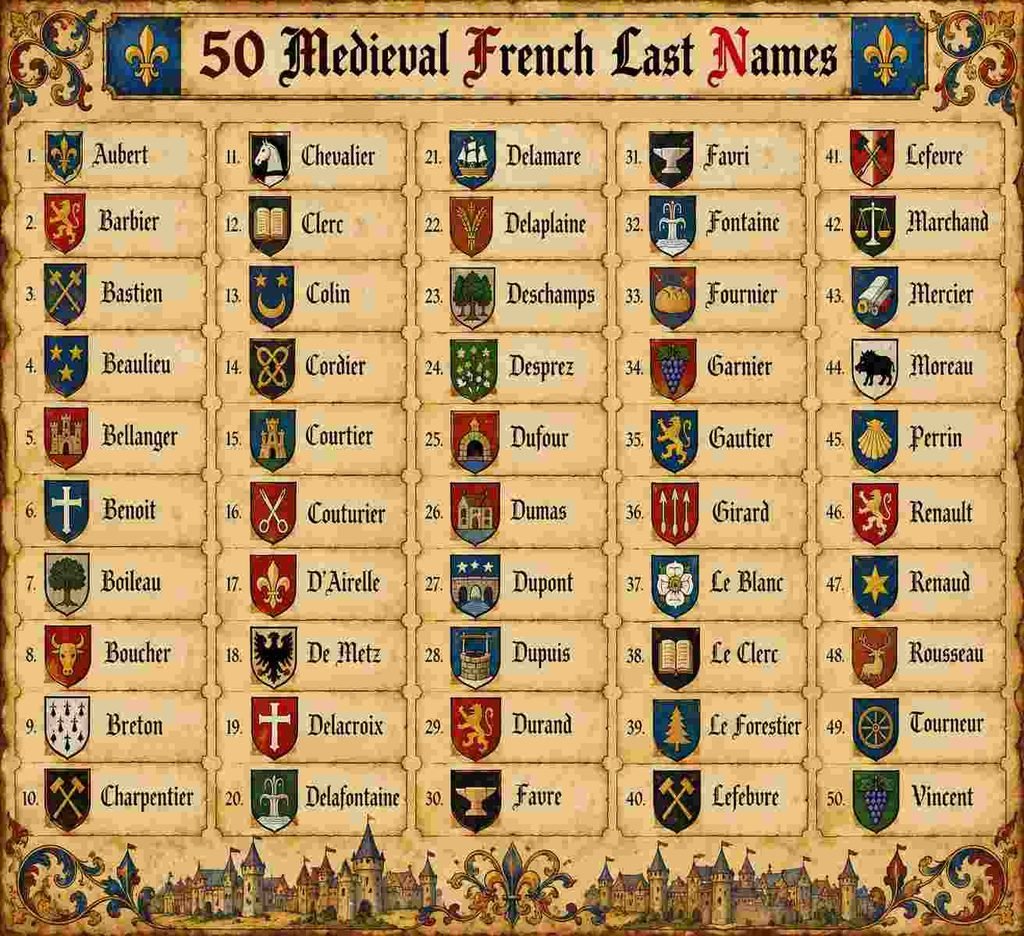
| Medieval French Last Name | Meaning or Origin |
| Aubert | From a medieval personal name related to Albert |
| Barbier | Occupational name for a barber |
| Bastien | From the personal name Bastien, a form of Sebastian |
| Beaulieu | “Beautiful place,” a place-based surname |
| Bellanger | From a medieval personal name derived from Germanic elements |
| Benoit | From Benoît, the French form of Benedict |
| Boileau | Associated with an old French nickname or descriptive name |
| Boucher | Occupational name for a butcher |
| Breton | Originally associated with someone from Brittany |
| Charpentier | Occupational name for a carpenter |
| Chevalier | From Old French chevalier, meaning knight or horseman |
| Clerc | Occupational name associated with a cleric or learned person |
| Colin | Diminutive form of Nicolas |
| Cordier | Occupational name associated with a maker or seller of cord |
| Courtier | Habitational surname associated with places called Courtier |
| Couturier | Occupational name for a tailor |
| D’Airelle | A Norman/French surname form recorded in medieval usage |
| De Metz | Habitational name meaning “from Metz” |
| Delacroix | “Of the cross,” a topographic or religious surname |
| Delafontaine | “Of the fountain,” referring to a place or feature |
| Delamare | “Of the sea” or “of the pool,” depending on the place of origin |
| Delaplaine | “From the plain,” a topographic surname |
| Deschamps | “Of the fields” or “from the fields” |
| Desprez | A surname connected with Old French pré, meaning meadow |
| Dufour | “Of the oven,” traditionally associated with an oven or baker |
| Dumas | “Of the manor/house,” associated with mas in southern France |
| Dupont | “From the bridge” |
| Dupuis | “From the well” |
| Durand | From the medieval personal name Durandus |
| Favre | An occupational surname related to a blacksmith |
| Favri | Medieval French occupational form connected with a blacksmith |
| Fontaine | “Fountain” or someone living near a spring |
| Fournier | Occupational name associated with a baker or oven |
| Garnier | Medieval French form of a Germanic personal name |
| Gautier | From a medieval Germanic personal name |
| Girard | From a Germanic personal name meaning associated with spear and strength |
| Le Blanc | “The white,” originally a descriptive nickname |
| Le Clerc | “The clerk” or learned man |
| Le Forestier | “The forester,” associated with forest work or administration |
| Le Roux | “The red-haired” or “the reddish one” |
| Le Verdier | Occupational name for a forester |
| L’Hernault | Associated with an Old French term for a herald or announcer |
| Martel | “Hammer,” possibly a nickname associated with strength |
| Mercier | Occupational name for a merchant or textile dealer |
| Meunier | Occupational name for a miller |
| Olivier | From the medieval personal name Olivier |
| Plantagenet | From Old French plante genest, “sprig of broom” |
| Roche | “Rock,” often a topographic or habitational surname |
| Roussel | A diminutive surname related to Roux, “red-haired” |
| Vauquelin | Old French form of the Norman name Walchelin |
| Vernon | A habitational surname associated with places named Vernon |
Some names above continued into later periods and are not exclusively medieval surnames. Medieval French naming was not standardized in the modern sense, so a surname may have medieval roots without having exactly the same spelling throughout the Middle Ages.
What Are Medieval French Last Names?
Medieval French last names were identifying names used alongside a person’s given name. They could describe where someone lived, what they did, who their parents were, or a noticeable physical or personal characteristic.
Genealogical sources commonly group French surname origins into several broad categories: patronymics based on personal names, occupational names, geographical or habitational names, and descriptive nicknames.
This means a medieval surname such as Meunier could identify someone by occupation, while Dupont could indicate a connection with a bridge or place called Le Pont.
Medieval French Occupational Surnames
Occupations were an important source of French surnames. Medieval communities often had several people with the same given name, so describing someone by their trade made identification easier.
Charpentier means carpenter, while Boucher is associated with a butcher. Fournier is connected with an oven or baker, Meunier means miller, and Mercier referred to a merchant or dealer.
Le Verdier is particularly interesting because Geneanet gives it as an occupational surname for a forester, from Old French verdier. Medieval forest officials known as verdiers were associated with the administration of forests.
Chevalier comes from Old French chevalier, meaning “knight” or literally a horseman. Geneanet and FamilySearch note that the surname was often likely a nickname or occupational designation connected with a knight’s servant rather than proof that every bearer belonged to the knightly class.
Medieval French Place-Based Last Names
Many medieval surnames identified people by where they lived or where they came from.
Names beginning with de, du, or des can sometimes reflect this pattern, although their presence does not automatically prove noble ancestry. For example, De Metz means someone associated with Metz, while Delaplaine can refer to someone living on or coming from a plain.
Beaulieu means “beautiful place,” while Fontaine refers to a fountain or spring. Roche is connected with a rock or rocky place, and Dupont refers to a bridge.
These names could arise independently in different parts of France, so sharing a place-based surname does not necessarily mean two families were related.
Medieval French Names Based on Personal Names
Some surnames developed from medieval given names. This is one reason many French surnames resemble traditional first names.
Durand, for example, comes from a medieval French and Spanish personal name documented in the Latinized form Durandus. FamilySearch connects the name with the Latin verb durare, meaning “to last” or “to endure.”
Other examples include Aubert, Garnier, Gautier, Girard, Colin, and Bastien. Many of these originated from older Germanic or Christian personal names that were adapted into medieval French forms.
Medieval French Descriptive Surnames
Nicknames based on appearance or personality could also become family names.
Le Blanc means “the white” and could originally have described someone with very light hair or complexion, although the exact reason for a particular medieval bearer cannot always be known.
Le Roux refers to someone reddish or red-haired, while Roussel is related to the same roux naming tradition.
Martel, meaning “hammer,” could have originated as a nickname, although individual family histories can have different explanations.
Medieval French Surnames With a Noble or Feudal Feel
Some medieval French surnames have strong associations with noble or feudal history, particularly names connected with estates, territories, or documented aristocratic families.
Plantagenet is one famous example. The name comes from Old French plante genest, referring to a sprig of broom. It became associated with the dynasty descended from Geoffrey V of Anjou.
Names containing de can also appear aristocratic, but the prefix itself should not be treated as automatic proof of noble status. Place-based naming was much broader than the nobility.
Historical collections of French feudal names document numerous families connected with fiefs and estates from the 12th century onward.
Medieval French Last Names for Characters
If you’re choosing a medieval French surname for a fictional character, consider matching the name to the character’s background.
For a merchant, names such as Mercier or Fournier can create an occupational connection. A rural character might suit a place-based name such as Deschamps or Fontaine. For a knightly setting, Chevalier has an obvious medieval association, although historically it should not automatically be interpreted as proof of noble birth.
For an aristocratic fictional family, a territorial-style name can create the right atmosphere, but it is better to use a documented historical family or place if historical accuracy matters.
Were Medieval French Surnames Spelled the Same Way?
Not necessarily. Medieval spelling was much less standardized than modern French spelling. A surname could appear in different forms depending on the document, region, language used by the scribe, and period.
This is particularly important when researching medieval genealogy. A modern spelling may not be identical to the form used by an ancestor centuries ago.
How to Choose a Medieval French Last Name
Start by deciding whether you want historical accuracy or simply a medieval French sound. For genealogy, research the specific family and region rather than relying only on the meaning of a surname. For fiction, consider whether the character’s occupation, location, or social setting matches the name. If you’re looking for masculine naming inspiration, French last names for boys can provide additional surname ideas.
Also remember that a surname having a medieval origin does not mean every person who uses that surname today descends from the same medieval family.
FAQs
What is a common medieval French last name?
There was no single standardized list of common medieval French surnames across all of France. Names varied considerably by region and developed from occupations, places, personal names, and nicknames.
What French surnames are medieval?
Names with documented medieval connections include Durand, Chevalier, Meunier, Fournier, Mercier, Garnier, Gautier, Delamare, Deschamps, and Le Verdier, among others. The exact spelling and usage could vary by period and region.
Did medieval French people have last names?
Yes, but surname use developed gradually. Geneanet notes that identifying surnames began appearing as populations grew, particularly from around the 10th to 12th centuries, and hereditary surnames developed at different rates.
Are all medieval French surnames noble?
No. Many came from ordinary occupations, locations, nicknames, and personal names. A surname with de or du does not by itself establish noble ancestry.
What is the oldest French surname?
There is no single universally accepted “oldest French surname.” Early naming practices varied by region, and identifying names gradually developed into hereditary surnames over the medieval period.
Final Thoughts
Medieval French last names reveal how people were identified in medieval communities. Occupational names such as Boucher and Meunier, place-based names such as Dupont and Fontaine, descriptive names such as Le Roux, and personal-name surnames such as Durand all reflect different naming traditions.
For historical research, the most important details are the spelling, region, date, and documentary evidence behind a particular surname. For fiction or character naming, these medieval naming patterns can provide a more authentic French historical feel without assuming that every surname belonged to a noble family.